



With less than a month left until the most-anticipated comebacks in the K-pop industry, BTS continues to be the most-talked-about group, and expectations are running high.
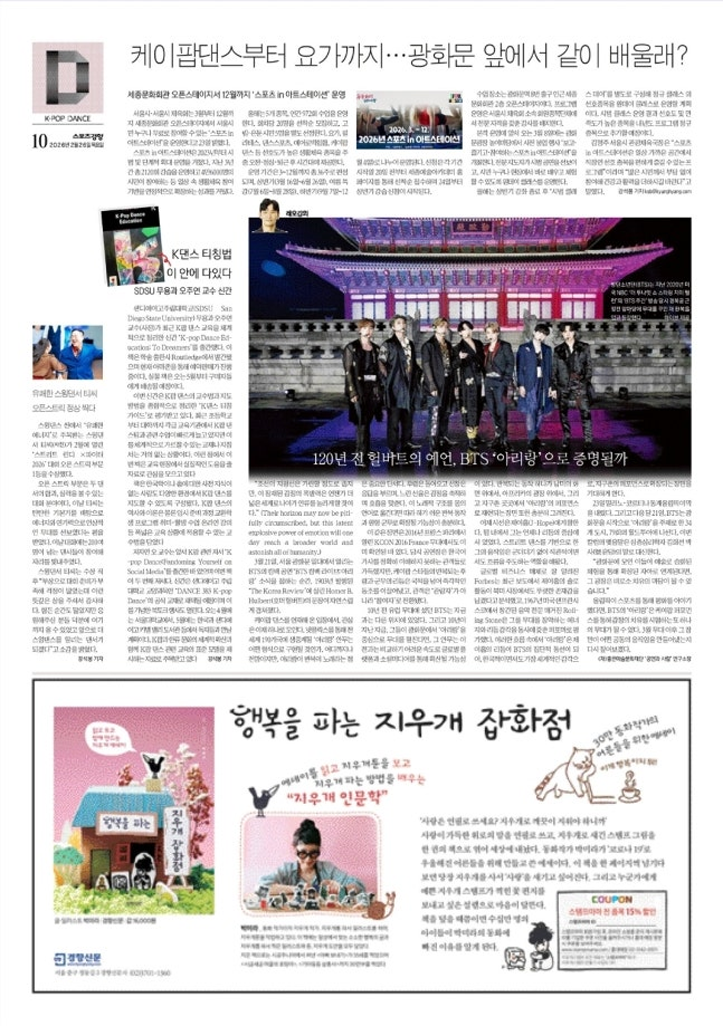
Recently, K-pop critic Leo Kang delved into BTS’s upcoming ‘ARIRANG‘ performance in Gwanghwamun, examining how the group might transform a century-old cultural prediction into a modern, global spectacle. Blending historical insight with an analysis of choreography and rhythm, Kang explores how BTS could turn repetition and movement into a shared emotional experience, inviting audiences worldwide to participate in a distinctly Korean yet universally resonant performance.
In a recently published column, Leo Kang refers to a quote spoken approximately 120 years ago – “Their horizon may now be pitifully circumscribed, but this latent explosive power of emotion will one day reach a broader world and astonish all of humanity.”

The critic wrote, “Upon hearing the news of BTS’s comeback performance ‘BTS Comeback Live: Arirang’ in the Gwanghwamun area of Seoul on March 21, the words of Homer B. Hulbert, published in The Korea Review in 1903, naturally came to mind.”
Leo further explained, “From the perspective of someone who has been following K-pop dance, the focus is clear: how will the choreography of ‘ARIRANG,’ to be broadcast live via Netflix to 190 countries, be realized? While speculative, one key clue lies in the song’s structure – it is a song of repetition. The chorus returns, the lead call invites a response, and the slow melodies build emotion and synchronize the audience’s breath. Translating this musical structure into physical movement suggests the choreography could expand into easy-to-follow repetitive moves and circular group formations.”
This type of effect was already witnessed at KCON 2016 France in Paris. The audience, many of whom did not fully understand the Korean lyrics, nonetheless responded instinctively to the repeating choruses and group choreography of K-pop stars, shifting from passive spectators to active participants. Ten years ago, BTS was on a very different stage in Europe. Now, if they perform Arirang at Gwanghwamun, the choreography has the potential to spread at unprecedented speed across global platforms and social media. One can easily imagine a single repeated move being mirrored in screens in South America, squares in Africa, and across the world as part of the Arirang performance.
Attention now turns to J-Hope. Within the team, he has always been at the heart of rhythm. His street-dance-based movements are both intuitive and flow-driving, guiding the group’s energy seamlessly.
Forbes recently noted that J-Hope’s solo activities have established a strong presence in the North American market, while Rolling Stone, the music magazine founded in San Francisco in 1967, described him as a performer who combines commanding stage energy with a refined sense of rhythm. Within this context, Arirang could allow J-Hope’s rhythm to guide BTS’s collective choreography, presenting a performance that is both distinctly Korean and universally resonant, extending as a global emotional experience.
The Milan–Cortina Winter Olympics concluded on February 23, and on March 21, BTS will begin a 34-city, 79-show world tour, starting in Gwanghwamun, centered on Arirang. The closing thought of this column is offered by depth psychologist Dr. Kim Hee Seon (pen name Yundam):
“If those gathered at Gwanghwamun connect through an artful, transformative experience, expanding their sense of self, the square itself can become a space of healing.”
If the Olympics spoke of peace through sport, BTS’s ‘ARIRANG’ may test the power of K-pop performance as a medium for emotional healing. After the March stage, we will revisit how this shared movement manifests among the audience.